Are Buyers Really Walking Away? What Chicago's Housing Market News Means for Downers Grove and the Western Suburbs
If you've been following real estate headlines lately, you may be wondering whether the housing market is finally shifting in favor of buyers. A recent Chicago-area housing report highlighted an increase in canceled home purchase contracts, fewer pending sales, and more negotiating opportunities for buyers. Nationally, housing market reports have also pointed to affordability challenges, price reductions, and buyers becoming more selective. At first glance, these headlines might suggest that sellers are losing their advantage and buyers are gaining the upper hand. But there's an important distinction that often gets lost in the headlines. The Chicago metropolitan housing market is not the same as the Downers Grove housing market. And Downers Grove is not necessarily experiencing the same conditions as Hinsdale, Westmont, Lisle, Glen Ellyn, or Naperville. For homeowners and buyers in Chicago's western suburbs, understanding those differences can have a significant impact on pricing, negotiating, and making the right real estate decisions.
What the Latest Chicago Housing Market Report Actually Says
An October 12, 2026, Patch article titled "Chicago Housing Market Sees A Surprising Shift In Buyer Behavior" highlighted findings attributed to Redfin's September housing market report. According to the article:
- 14.1% of Chicago metro home purchase contracts were canceled in September, compared with 14.5% nationally.
- Pending home sales in the Chicago metro area declined 5.8% compared with September 2025.
- The number of homes available for sale increased slightly, by 0.6% year over year.
- Closed home sales declined 2.3% compared with the previous year.
The broader message is that buyers are becoming more cautious, affordability remains a concern, and sellers may need to be more flexible. These trends deserve attention. However, they also raise an important question: How much of this information actually applies to someone buying or selling a home in Downers Grove? The answer depends on the local market, the property, the price range, and the competition.
Why Chicago Metro Housing Statistics Can Be Misleading
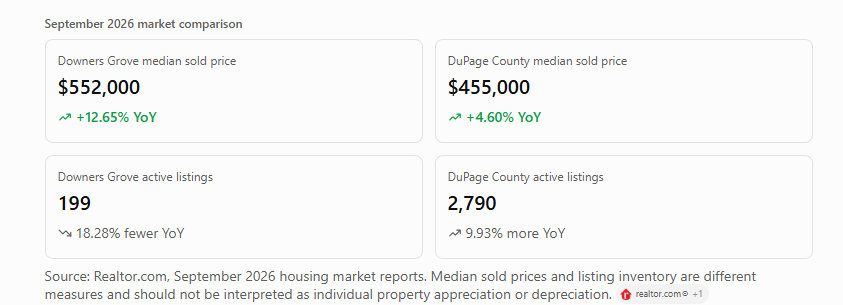
Consider the actual September 2026 numbers. According to Realtor.com, Downers Grove recorded a median sold price of approximately $552,000, up 12.65% from the previous year, while active listings declined more than 18%. Across DuPage County, active inventory increased nearly 10%, and median sold prices rose a more modest 4.6%. In other words, while the broader market is showing signs of greater inventory and buyer flexibility, Downers Grove is exhibiting different trends. This is exactly why buyers and sellers should be cautious about applying national or Chicago metro headlines to their own neighborhood.
One of the biggest challenges with national and metropolitan real estate reporting is the size and diversity of the markets being measured. The Chicago metropolitan area encompasses an enormous variety of housing markets, including downtown condominiums, city neighborhoods, established suburban communities, luxury properties, entry-level homes, and new construction. Combining all of those properties into one statistical report can obscure what is happening within an individual community. Consider the differences between a downtown Chicago condominium and a four-bedroom single-family home in Downers Grove. These properties attract different buyers, face different inventory conditions, and compete within different price ranges. Even within Downers Grove, the market for a smaller ranch home may behave differently from the market for a newer luxury home near downtown. A buyer searching for a walkable location near the Downers Grove Metra stations may have different priorities from someone seeking a larger lot, more square footage, or a particular school attendance area. That is why broad market statistics should be treated as context, not as a substitute for local analysis. A metropolitan market can experience slowing sales while certain suburban neighborhoods continue to attract strong buyer interest. The reverse can also be true.
Is Downers Grove a Buyer's Market or a Seller's Market in 2026?
This is one of the most important questions buyers and sellers are asking. The answer cannot be determined from Chicago metro statistics alone. A true assessment of the Downers Grove housing market requires looking at several local indicators:
- Active inventory: How many homes are currently available in a particular price range?
- Months of supply: How long would it take to sell the available inventory at the current sales pace?
- Days on market: How quickly are comparable homes going under contract?
- Sale-to-list price ratios: Are buyers paying asking price, negotiating below it, or competing above it?
- Price reductions: Which properties are reducing their asking prices, and why?
- Contract activity: How many homes are going under contract compared with the number of new listings?
- Property-specific demand: Are certain locations, home styles, conditions, or price ranges attracting more interest?
These indicators help reveal whether buyers or sellers have the stronger negotiating position. Importantly, the answer may differ from one segment of the market to another. A well-maintained home with a desirable floor plan and competitive pricing may face relatively limited competition. Meanwhile, an overpriced property requiring significant updates may spend considerably longer on the market. Both situations can exist at the same time, in the same community. This is where local expertise becomes especially valuable.
Are More Homebuyers Canceling Contracts?
The Chicago-area cancellation rate reported by Redfin is certainly worth watching, but it does not establish that Downers Grove buyers are canceling contracts at the same rate. There are several reasons a real estate transaction may fall through. A buyer may discover unexpected issues during a home inspection. An appraisal may come in below the agreed purchase price. Financing circumstances may change. Buyers may also reconsider a purchase when monthly payments, property taxes, insurance, or anticipated repairs exceed their comfort level. These situations are not necessarily evidence of declining demand. In some cases, they reflect buyers being more financially disciplined. For sellers, the takeaway is not to assume that buyers are disappearing. It is to understand how to reduce uncertainty before a property reaches the market. Thoughtful pricing, appropriate preparation, clear property information, and careful evaluation of offers can all help support a smoother transaction. For buyers, the lesson is equally important. A more cautious market may create opportunities to negotiate, but those opportunities still depend on the individual property and its competition.
What We're Actually Seeing in Downers Grove: The Glover Team's Perspective
From our own experience at The Glover Team, we can tell you that the increase in canceled contracts isn't just something we're reading about. We're seeing what feels like an uptick in transactions falling apart on both the buying and selling sides here in Downers Grove and the surrounding western suburbs. And frankly, it doesn't surprise us. One of the biggest challenges in our local market is that buyers are often being asked to make very big decisions very quickly. Desirable, well-priced homes can sell within the first few days, and some never even make it to the public market before finding a buyer. That creates a sense of urgency, particularly for buyers who have already missed out on other properties. When a home checks most of the boxes, buyers know they may not have much time to think it over. They make aggressive offers, sometimes compete against multiple buyers, and then have a little more time to process the decision once they're under contract. That's when things can get complicated. While every transaction is different, we've noticed a few recurring situations that seem to be contributing to canceled contracts locally.
1. Home inspections are becoming more extensive, and buyers are taking the findings seriously.
We're seeing buyers approach inspections with greater scrutiny. Beyond the traditional general home inspection, buyers are increasingly looking into potential mold, radon, foundation concerns, water intrusion, pest activity, and roof conditions. One issue that deserves particular attention is homeowners insurance. We've encountered situations where the age or condition of a roof creates challenges with obtaining acceptable insurance coverage. Depending on the insurer and the property's condition, a roof that appears to have useful life remaining may still create underwriting concerns or require repairs or replacement. That can quickly turn what seemed like a manageable inspection item into a much bigger financial issue, and in some cases, it can jeopardize the entire transaction.
2. Buyers win a bidding war, then start second-guessing the price.
This is an interesting dynamic we're seeing in competitive situations. A buyer may stretch their budget or offer more than they initially planned because they don't want to lose another house. Once the excitement of winning wears off, they may begin questioning whether they paid too much. Sometimes that hesitation shows up during inspection negotiations. Buyers may seek additional credits or repairs, hoping to recover some of what they feel they gave up in the bidding process. But here's where the local market can tell a very different story from the national headlines.
The seller may still have another interested buyer waiting in the wings.
If a home received multiple offers, the seller may have backup buyers who would welcome another opportunity to purchase it. That can significantly affect how much negotiating leverage the original buyer actually has. In other words, a buyer may feel the market is shifting in their favor, while the seller still has strong alternatives.
3. Mortgage rate changes can affect affordability after an offer is accepted.
With home prices and monthly payments already stretching many buyers' budgets, even a relatively small change in mortgage rates can make a difference. If a buyer hasn't locked their interest rate, an increase between the time they submit an offer and the time they finalize financing can change their anticipated monthly payment. For buyers already near the top of their comfort zone, that added expense may be enough to reconsider the purchase.
4. Buyers move quickly, then realize another home may be a better fit.
We've also seen how the pressure to act quickly can lead buyers to commit before they've fully processed whether a property is the right one. They get excited, make an offer, and secure the house. Then another property becomes available, or they have time to reflect on the compromises they made. Suddenly, the home they were so determined to win doesn't feel quite as perfect. This doesn't necessarily mean the original property was overpriced or undesirable. Sometimes it simply means the buyer made a decision under pressure and later had second thoughts.
What Does This Mean for Buyers and Sellers?
What makes this market particularly interesting is that we're seeing signs of buyer hesitation and strong competition happening at the same time. Those two things might sound contradictory, but they're not. Buyers can be cautious about affordability, inspections, and long-term costs while still competing aggressively for homes they really want. For sellers, this means getting an offer is only part of the equation. Evaluating the buyer's financing, contingencies, overall commitment, and likelihood of closing is just as important as the purchase price. For buyers, it means having a clear strategy before the right home becomes available. Understanding your budget, your tolerance for repairs, and where you're willing to compromise can help prevent costly second thoughts after going under contract. This is also why we believe local experience matters so much. At The Glover Team, we're not just watching housing statistics. We're actively involved in the conversations, negotiations, inspections, and challenges that happen between an accepted offer and the closing table. And what we're experiencing firsthand reinforces that a canceled contract doesn't necessarily mean a weak housing market. Sometimes it reflects the pressure, competition, and complexity of a market where desirable homes are still in demand.
How the Housing Market Can Differ Across Chicago's Western Suburbs
Even neighboring communities can experience different market conditions.
Downers Grove: Housing options range from established neighborhoods and classic mid-century homes to updated properties and newer construction. Proximity to downtown Downers Grove, commuter rail access, neighborhood amenities, and individual property characteristics can influence demand.
Hinsdale: A significant luxury housing segment, established neighborhoods, and custom homes create a market with different pricing considerations. Higher price points can also mean a smaller pool of comparable properties.
Glen Ellyn: Downtown character, commuter access, and a mix of established and updated homes attract buyers with varying priorities. Location and condition can create meaningful differences between listings.
Naperville: With a large geographic footprint and a wide range of housing options, Naperville cannot be accurately described by one price trend. Market conditions may vary considerably between neighborhoods and price ranges.
Lisle and Westmont: These communities offer their own combinations of commuter access, housing styles, and price points. Their inventory and buyer demand should be evaluated independently rather than assumed to follow Downers Grove.
The important point is not that one suburb is universally stronger than another. It is that each community has its own inventory, buyer pool, and competitive dynamics. A regional headline cannot fully capture those differences.
What Chicago's Changing Housing Market Means for Downers Grove Sellers
If you're considering selling your home in Downers Grove, a headline about falling sales or rising cancellations should not automatically convince you to lower your expectations. It should encourage you to approach your sale strategically.
Pricing accurately matters more than following national trends
One of the most costly mistakes a seller can make is using broad market commentary to determine a listing price. Your home's value is influenced by what buyers are willing to pay for comparable properties in your immediate market. That includes recent closed sales, competing active listings, pending transactions, property condition, lot characteristics, and location. A home priced correctly for its market can generate meaningful interest even when broader housing activity slows. Conversely, a property priced above what comparable sales support may struggle even in a relatively competitive market.
Presentation and preparation can influence buyer confidence
When buyers become more selective, property condition and presentation may carry greater weight. Professional photography, appropriate staging, strategic improvements, and a well-planned marketing launch help buyers understand the value of a property. That does not mean every seller needs to complete major renovations. It means understanding which improvements are likely to matter to buyers in that particular neighborhood and price range.
Negotiating strategy should reflect actual buyer demand
Some sellers may benefit from offering closing cost assistance or addressing inspection concerns. Others may have enough interest to prioritize stronger pricing or more favorable contract terms. The right approach depends on the property's competitive position. The goal is not simply to sell a home. It is to protect the seller's interests while creating the strongest possible opportunity for a successful closing.
What the Market Shift Means for Buyers in Downers Grove
For buyers, headlines about reduced competition can sound encouraging. But assuming every home is negotiable can be just as risky as assuming every home will receive multiple offers. In Downers Grove and the surrounding suburbs, buyers should evaluate opportunities individually. A property that has been listed for several weeks may offer negotiating flexibility, particularly if it is priced above comparable homes or requires improvements. A recently listed home in a desirable location with limited comparable inventory may present a different situation. Buyers should also consider the total cost of ownership, including property taxes, insurance, maintenance, and financing. Mortgage rates matter, but so do the purchase price, available inventory, and the home's long-term suitability. The best buying strategy is based on current local competition rather than an assumption that the entire housing market is moving in one direction.
Why Working With a Local Downers Grove Real Estate Expert Matters More Than Ever
Real estate data is more accessible than ever. Buyers and sellers can find home values, market forecasts, mortgage rate commentary, and national housing reports with a quick online search. But having access to information is not the same as knowing how to interpret it. That is the difference between reading about the housing market and understanding the market in which you are actually buying or selling. An experienced local real estate professional can evaluate information that broad market reports often miss. For example:
- Which neighborhoods or pockets are attracting buyer interest?
- Which listings have reduced their prices, and what do they have in common?
- How does a home's condition compare with recent successful sales?
- Are buyers in a specific price range showing greater negotiating flexibility?
- What contract terms could strengthen an offer without creating unnecessary risk?
- How does one neighborhood's current inventory compare with another's?
These questions require more than a national forecast or a metropolitan average. They require current local market knowledge, careful comparable-sales analysis, and experience navigating real transactions. Sabrina Glover and The Glover Team helps buyers and sellers in Downers Grove and the surrounding western suburbs make decisions based on the market directly relevant to their goals. Rather than applying a one-size-fits-all interpretation of the latest headlines, the focus is on understanding each property's position within its local market and developing a strategy accordingly.
The Bottom Line: Real Estate Is Local, Even When the Headlines Are National
The latest Chicago housing market headlines offer valuable insight into the broader economy and changing buyer behavior. They tell us that affordability matters, buyers are evaluating purchases carefully, and sellers need to pay attention to pricing and competition. What they do not tell us is exactly what your home is worth, how quickly it might sell, or how much negotiating power you have in a specific Downers Grove neighborhood. Those answers require a closer look. Whether you're preparing to sell, searching for your next home, or simply trying to understand how recent market changes may affect your property value, local knowledge provides the context that broad headlines cannot. Before making a real estate decision based on what you're reading about Chicago or the national housing market, find out what's actually happening in your neighborhood. Connect with Sabrina Glover and The Glover Team for a personalized look at the Downers Grove and western suburban real estate market, including recent comparable sales, current competition, and a strategy tailored to your goals.
So...
Are home prices dropping in Downers Grove in 2026?
A slowdown in national home price growth does not necessarily mean home values are declining in Downers Grove. Local price trends should be evaluated using recent comparable sales, property types, price ranges, and neighborhood-level activity.
Is now a good time to sell a home in Downers Grove?
It can be, depending on your home's condition, location, price point, available competition, and personal goals. The most useful starting point is a current comparative market analysis rather than a national housing forecast.
Do buyers have more negotiating power in Chicago's western suburbs?
Some buyers may have additional negotiating opportunities, particularly with homes that have been on the market longer or need improvements. However, negotiating power varies by community, property type, and inventory conditions.
Are homes taking longer to sell in Downers Grove?
The Chicago metro's broader slowdown does not establish how quickly homes are selling in Downers Grove. Current local days-on-market data, especially for comparable homes, provides a more accurate picture.
Who can help me understand the Downers Grove real estate market?
A real estate agent who regularly works in Downers Grove and nearby western suburbs can provide property-specific pricing guidance, neighborhood-level market analysis, and negotiation strategies. With more homes sold than any other agent in Downers Grove this year, Sabrina Glover of The Glover Team offers that local perspective to buyers and sellers evaluating their next move.
Sources and Further Reading
- Patch, Eric DeGrechie, "Chicago Housing Market Sees A Surprising Shift In Buyer Behavior," October 12, 2026.
- Redfin, Housing Market Data, for regional housing market trends and contract activity.
- Midwest Real Estate Data (MRED), for local MLS listing, pending sale, and closed sale information.
- Illinois REALTORS, for statewide and regional housing market reporting.
- National Association of REALTORS, for national housing market trends and research.
Market commentary reflects the October 2026 reporting discussed above. Property-specific conditions and local market indicators should be verified using current MLS data before making pricing or purchasing decisions.